s10errormessage( ). data:
myexplanation type string,
myhtmlformat type string,
mymsgid type sy-msgid,
mymsgno type sy-msgno,
mynoexplanation type string,
mypar1 type string,
mypar2 type string,
mypar3 type string,
mypar4 type string,
mytext type string.
s10errormessage(
exporting
explanation = myexplanation
htmlformat = myhtmlformat
msgid = mymsgid
msgno = mymsgno
noexplanation = mynoexplanation
par1 = mypar1
par2 = mypar2
par3 = mypar3
par4 = mypar4
text = mytext ). | Name | Type | Description |
| explanation | string | Message explanation |
| htmlformat | string | 'X' = message text is in HTML |
| msgid | sy-msgid | Message Id table T100 |
| msgno | sy-msgno | Message number table T100 |
| noexplanation | string | No explanation display |
| par1 | string | Message parameter 1 |
| par2 | string | Message parameter 2 |
| par3 | string | Message parameter 3 |
| par4 | string | Message parameter 4 |
| text | string | Messsage text |
ABAP
if vtimehhmm > etimehhmm.
  s10errormessage( 'Start time is after end time' ).
endif. 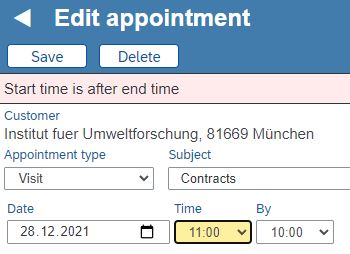
If you have defined an element of the class in the HTML page
HTML
<div class="messagearea"></div>the message will be displayed there. Otherwise, it appears as a popup:
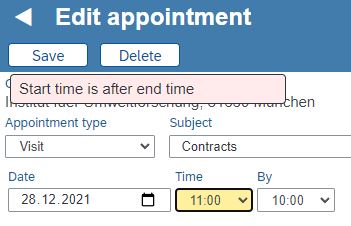
The popup is displayed below the HTML element that triggered the action, in
this example the Save button.
If an explanation is to be displayed with
the error message, the display as a popup is always used.
If the error
message results from a check method of the object, the attribute to be
checked receives the input focus. If several attributes are checked, the first
attribute receives the input focus.
ABAP
* validations
   methods:
      validate_time
        importing
          vtimehhmm type string
          etimehhmm type string.   method validate_time.

* correct times?
    if vtimehhmm > etimehhmm.
      s10errormessage( 'Start time is after end time' ).
    endif.

endmethod. ABAP
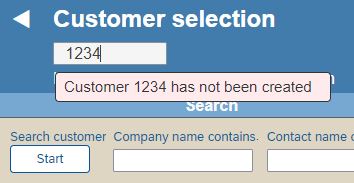
s10errormessage( s10localize( 'TIME_INTERVAL_ERROR' ) ).The placeholders &1, &2, &3, &4 will be replaced in the text by the specified variable values. When passing the parameters, remember to produce the external format so that, for example, a customer number is displayed without leading zeros. Example:
ABAPs10errormessage(
exporting
msgid = 'F2'
msgno = '153'
par1 = s10getuservalue( 'kunnr' ) ).
Example of using a standard SAP message with explanation:
ABAP
s10errormessage(
         exporting
           msgid = '00'
           msgno = '058'
           par1 = search_land1
           par4 = 'T005').
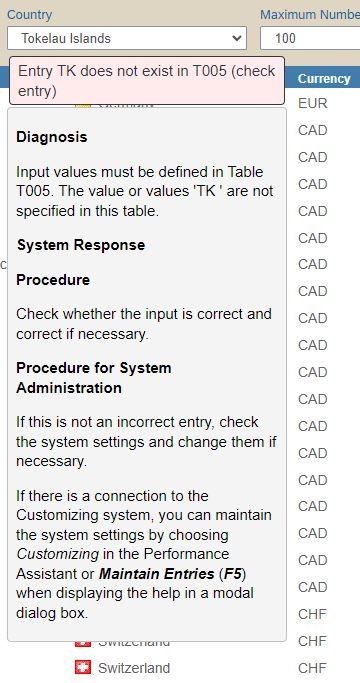
The message itself is output as text without formatting. If you need special formatting, you can set the parameter "htmlformat = 'X' " and use HTML in the message text:
ABAP
s10errormessage(
         exporting
          text = |Country key  |
                 && search_land1 && ||
                 && | not included in table T005|
          htmlformat = 'X' ).
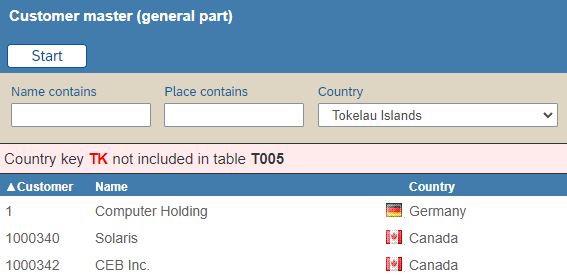
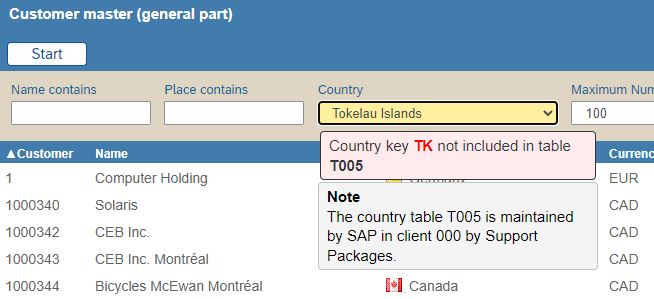
This then also refers to an explanation given with "explanation":
ABAP
s10errormessage(
exporting
 text = |Country key  <span style='font-weight:bold;color:red'>|
        && search_land1 && |</span>|
        && | not included in table <b>T005</b>|
  explanation  = |<b>Note</b>|
        && |<br>The country table T005 is maintained by SAP |
        && |in client 000 by Support Packages.|
  htmlformat  = 'X' ).